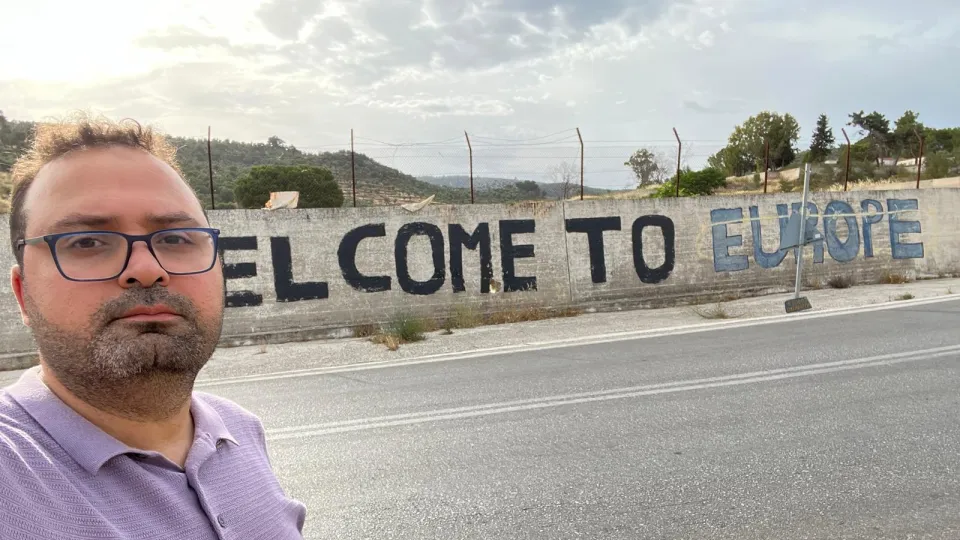
At Europe’s borders, people disappear from view
Refugees at the Bosnia-Croatia border are regularly subjected to violent pushbacks. They can quickly disappear from view: without a phone, without access to support, protection or justice. Our local partners continue to document their stories. But their work is coming under increasing pressure.

Pushbacks
‘I have been pushed back fifteen times,’ says Ahmad*, a 19-year-old from Algeria. He is wearing a cap with the words Jesuit Refugee. Together with others, he says he was forced by Croatian border guards to cross a river at night.
‘It was snowing and the water came up to our necks. An older man fell on the rocks, and the border guards laughed at him.’
Ahmad’s money and phone were taken from him. For refugees on the move, losing a phone means losing a map, contact with family and a way to call for help. It can also mean losing the possibility to document what has happened to them.
After every violent pushback, Ahmad faces the same uncertainty: where will he sleep, how can he get help, and how long will he remain stuck in a situation where he can neither move forward nor go back?

Not an isolated incident
Ahmad’s story is not an isolated case. Between August 2024 and September 2025, Save the Children teams in Bosnia and Herzegovina reached 1,691 people who reported being violently pushed back from Croatia. Among them were 258 children. Aid workers regularly encounter people who have lost their phones, money or other belongings, and some have also suffered injuries.
According to aid organisations, stricter border controls do not stop refugees and migrants from moving. Instead, they push people towards more dangerous and less visible routes. This increases their dependence on smugglers, while at the same time fewer organisations can monitor what is happening at the border.
As a result, not only people but also their stories increasingly disappear from view.
The game: a dangerous journey
Along the Balkan route, people often call an attempt to cross from Bosnia and Herzegovina into Croatia ‘the game’. But it is anything but a game.
It is a dangerous journey through forests, mountains and rivers. People stopped by the police in Croatia risk violence, robbery, detention or a pushback.
Connecting what happens on the ground
Stories such as Ahmad’s and reports of pushbacks do not automatically reach organisations and policymakers outside the Bosnia-Croatia border region.
The Centre for Peace Studies (CPS), the Croatian partner organisation of the Dutch Council for Refugees, therefore, works closely with civil society and human rights organisations, aid organisations and legal partners in both Croatia and Bosnia and Herzegovina.
Through this network, it is not only statistics and reports that reach a wider audience. The personal stories behind those reports and pushbacks also become visible.
The essential work of CPS
‘CPS does not represent people in court itself, but we work closely with lawyers,’ explains legal adviser Luka Kos. ‘We prepare the documents and determine which information is important. The lawyer then takes the case to court.’
CPS aims not only to support individuals, but also to expose structural problems. However, following the withdrawal of USAID funding and other funding cuts, the organisation has shrunk by more than half since 2025. At the same time, the space available to civil society organisations is becoming increasingly restricted, often because of political pressure.
‘Less capacity means less time to monitor what is happening to people at the borders,’ says project manager and lawyer Andrea Jelovčić. ‘Less time to prepare cases and provide legal support.’
Andrea is also concerned about the introduction of the EU Migration Pact.
‘With the new border procedures, access to independent support is becoming even more important, and potentially more difficult.’


Fear of speaking out
Alongside testimonies and documentation collected by civil society organisations, independent monitoring is also crucial.
According to Vanya Bakalovic, adviser to the Croatian Ombudswoman, her office has been hearing reports about problems accessing protection for years. But investigating these reports is difficult when people are afraid to share their name, location or other personal details.
Andrea recognises the same problem in the work of CPS.
‘Many people are afraid to report violence or a pushback while they are still in Croatia or waiting for a decision on their asylum application,’ she explains. ‘Without names, details or official reports, it becomes much more difficult for us to investigate, gather evidence and prepare cases.’
This is precisely why local organisations are indispensable. They listen, document patterns and look for safe ways to use information and take legal action.
Their work helps ensure that possible human rights violations can be investigated, responsible authorities can be held to account, and pressure can be applied to prevent further pushbacks and safeguard access to asylum.
Keeping what happens at the border in view
Meanwhile, little has changed for Ahmad. He does not know how long he will remain in limbo.
He does not tell his family what he experiences at the border because he does not want them to worry. Above all, he wants to continue his journey and find a place where he can build a future.
Not every story leads to a court case. Not every testimony immediately changes policy. But without local organisations that listen, document and identify patterns, what Ahmad tells us remains only a story. That is why we need to keep looking, keep documenting and keep asking what is happening at Europe’s borders.
*Ahmad’s name has been changed to protect his privacy. His real name is known to us.
Onze steun aan lokale partners
What happens at Europe’s external borders often remains out of sight. That is why we support local organisations such as the Centre for Peace Studies (CPS). They listen to the experiences of refugees and bring possible human rights violations to wider attention.
Want to learn more about our international cooperation and partner organisations? Explore our international projects.
Support refugees around the world
Everyone deserves protection, no matter where they are. We support local partner organisations outside the Netherlands with funding, legal expertise and knowledge-sharing. Because together, we can make a greater impact. Want to support our international efforts?