Aliou: Driving a migrant boat makes me a hero or a criminal?
Over the last decade, thousands of people have been arrested by the Italian government based on human smuggling charges. According to the Italian authorities, these people are accused of driving a migrant boat toward its shores. However, these individuals are mostly refugees themselves seeking safety. And occasionally, the smugglers force them to drive the boat. The story of Aliou, a refugee from the Gambia, is an example of such tragedy.

Aliou, who is now 26 years old, travelled from the Gambia to Libya seven years ago with a friend, in search of a new life. A couple of days before their departure on a boat, the smugglers informed them that there would be no boat driver, and that one of them needed to do it. When Aliou's friend refused to operate the boat, the smugglers shot him down, and he died, while Aliou managed to escape.
No driver on board
After that, Aliou attempted many times to take another boat. In his first attempt, the boat sank. Eventually, he boarded a boat that successfully reached the Italian territorial waters. Yet again, there was no boat driver, something that left Aliou with no choice but to take the helm. “I had to drive the boat because there were 120 people on board. I wanted them to reach Italy safely.” Upon their arrival on the Italian island of Sicily, Aliou was arrested, suspected of operating the boat.
I had to drive the boat without having any previous experience. By doing that, I saved the lives of many people.
Aliou uit Gambia
Behind bars
Despite a weak preliminary investigation, the Italian government imprisoned him for “the act of driving a boat with migrants on board.” After six and a half years, Aliou was finally released. However, he won't be able to get protection in Italy due to the criminal records that he now holds. While relieved to be out of prison, his future remains uncertain.

The Libyan Route
In Libya, human traffickers are well aware of the situation in Italy. Therefore, they operate in such a way that reduces their chances of being arrested themselves. They make use of bigger “motherships” that release small, often unseaworthy and overcrowded boats not far from Libyan waters. These small boats are mostly old and reused, with migrants and refugees themselves serving as the crew. Three individuals are tasked with navigating the boat: One handles the compass, another manages the steering wheel, and a third makes a satellite emergency call just before the boat is cast off from the mothership. By forcing migrants to operate the boats themselves, Libyan smugglers effectively evade arrest and persecution.
From sea to prison
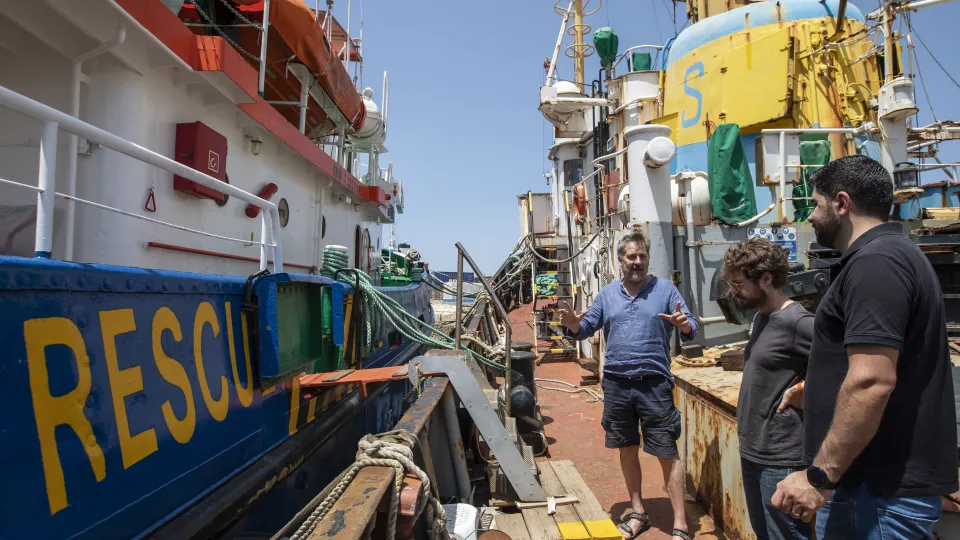
Porco Rosso, a Sicilian partner organisation of the Dutch Council for Refugees, conducted research on the criminalisation of migrants, specifically those who drive the boats. In 2020, their research revealed that Italy had imprisoned thousands of people, accusing them of human smuggling because they steered the boats carrying migrants toward Italian shores. In most cases, these individuals, just like Aliou, had no choice but to take on the role of boat drivers.

It has become routinge. Whenever a boat arrives, one to three people are accused and arrested.
Richard Braude, Porco Rosso
The Dutch Council for Refugees Supports Italian partner Organisation
The Dutch Council for Refugees is working with our Italian partner organisation Porco Rosso to help refugees and asylum seekers who have just arrived in Italy via boats. Porco Rosso is an organisation of many volunteers that provide legal and procedural assistance.